Creator Saga

Creator Saga

Where endless role-playing, competitive trading card, and tactical strategy games meet.

A game by Chris Lemmon

Coming to Kickstarter — Spring 2027

Get Notified
Scroll
Watch on Twitch Watch on YouTube

Setting up the board…

What is Creator Saga?

Two to eight players. Any table or battle map. Hundreds of cards, no two hands alike.

The world’s first Tactical Role-Playing Card Game. Create your character from the six SPIRIT attributes, then play it out on a battle map or in the theatre of the mind.

Read on to learn more.

Live · a real battle Step in ⤢
Your seat at the tableSet the way the rules set it. Pick anything up.
Loadout 1
Stat Block
Key Passives
Loadout 2
Side Board
Your Hand

Swipe to look around the table

Hungry for more?Good. There is more to read and more to know.

Read all the FAQs

A seat is set for you

Be First to Play

Creator Saga is headed to Kickstarter in Spring 2027. Sign up to get notified when we launch — plus early access to playtest opportunities.

Count Me In

No spam. Just updates when something real happens.

Counting down to launch…
until Creator Saga opens on Kickstarter
The Stat Block
Six attributes. Every stat, for every character, derived from them.

Build your Stat Block

The Side Board
Kept face down beside the Table.

Your hand is what you bring to this fight. Your side board is what you could bring next round: more skill cards, other Key Passives and weapons, all legal for your Stat Block, plus the creatures you summon or turn into.

What Is Creator Saga?
Where Role-playing games and Trading card games meet.

Creator Saga is a Tactical Roleplaying Card Game (TRPCG) for 2–8+ players. Create your character from the SPIRIT system where all aspects of play are derived. Through the theatre of the mind or a full battle map with minifigures, you play out your creation.

The game draws from two traditions. From tabletop RPGs: deep character building, a living world, and campaigns where your choices shape the story. From competitive card games: hidden skill loadouts, resource management, and a reaction system where you’re never waiting for your next turn.

Two ways to play.

Skirmish

Head-to-head tactical PvP — build a character, pick your skills, and outthink your opponent in 15–30 minute matches.

Campaign

The full RPG experience — level up, explore the world of Erand, and take on adventures with your group.

FAQs

Endless Lore
Create your own saga. Erand has a rich history to jump from.

Creator Saga doesn’t hand you a story to finish. It hands you a world to write in. Every Campaign is a new saga, and the players are its authors: the heroes they build, the rivals they make, the oaths they break, the last stand they choose.

You can begin from nothing, and many tables will. But you never have to. Erand’s history runs back before the beginning: the Chancellors who made the world, the Calamity that unmade it, sixteen centuries of the Long War, and the Dimming spreading now, in the thirty-fourth year of the Third Epoch. Every age left wars nobody finished, cities nobody has heard from, and questions the records refuse to answer.

Before the Reckoningthe gods and the twins
The First Epochthe Age of Creation
The Calamitythe year nothing
The Second Epochthe Long War · 1–1602
The Third Epochnow · year 34

The Chronicle of Mordecai is that history as far as one man could prove it, and he says plainly where his record stops. Everything past that line is yours.

Places to begin

Read the Chronicle of Mordecai

The Player’s Handbook
Simple to learn. Impossible to master.
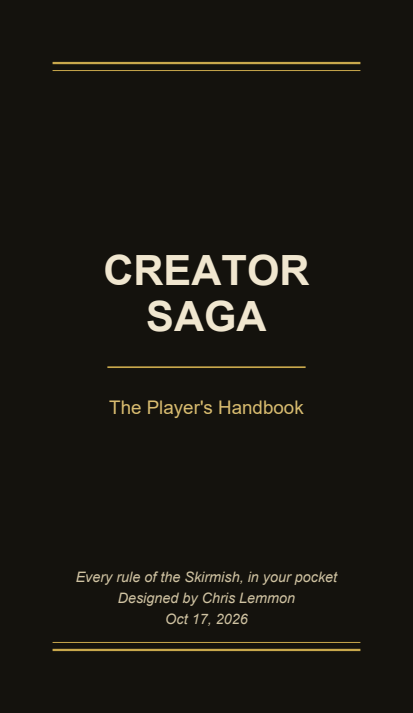
The cover of the Player’s Handbook

The whole rulebook of Creator Saga fits in a pocket handbook you can read in a sitting.

The rules you need to sit down and play are short: six attributes, four phases to a round, and the Chain, where every action and reaction resolves. Everything else is printed on the cards themselves, right where you need it.

The Core set is everything you need to start: the Handbook and a 78-card deck of Universal and Core skills, weapons, creatures and Stat Block cards. Booster packs add more archetype cards.

Open the Handbook

Skill Cards
Build your hand. Hide your strategy. Reveal it when it matters.

The Loadout

Every skill in Creator Saga is a physical card with a type, a resolution method, and attribute requirements your character must meet to equip it. Before each battle, you build a Skill Loadout — selecting which skills to bring. Your Hand Size is your Primary attribute: the higher it is, the more cards you carry. Talent sets your Skill Power, the highest tier you can play a card at, so the same card hits harder as your character grows.

Single-attribute skills reflect the raw identity of each SPIRIT attribute. Dual-attribute skills combine two attributes into powerful, specialized abilities — and there are 30 dual-attribute archetypes to explore.

Hidden Information

Your loadout is hidden. Your opponent doesn’t know if you’re carrying a counter spell or a point-blank execution until you play it. Every reveal changes the battlefield.

Resolution Types

Skills resolve in four ways: Attack rolls test your aim against evasion. Force rolls make your target resist your will. Apply effects land without a roll. Utility checks test your ability against a static challenge. The type line on each card tells you exactly what to expect — no ambiguity, no guesswork.

Think deck building, but instead of having to draw through 60 cards hoping to find the magic combo, you build a tight, powerful hand and bring every card to the fight.

Build a Hand

It opens with Bryn’s eight cards already in hand. Swap any of them, or start your own.

Match Formats
Multiple ways to play — from quick duels to epic campaigns

There are multiple ways you can play Creator Saga. From a simple Skirmish between two players, a strategic battle between a room full of friends, or the cooperative Campaign. Ultimately there are unlimited ways you can play. So get creative and have fun!

1v1 Duel

No MC required. Players adjudicate honestly. Can be played on a battle map or just the theater of the mind. Often enhanced with Companions — additional characters controlled by each player.

Team Battles (2v2 and Beyond)

Requires an MC to help moderate. Teams compete until only one remains standing. Battle map required to maintain clarity, balance, and pacing.

Capture the Crown

Teams compete against each other and NPCs to extract the crown. The MC sets up the map, crown location, and selects, places, and controls the NPCs. Victory is achieved by returning the crown to your team’s base, or by eliminating the opposing team.

Raid Night

Designed for large groups — typically 8+ players. Face off against powerful, MC-controlled bosses that demand coordination, strategy, and optimized builds. Success requires teamwork, planning, and precise execution of battle doctrines.

Campaign

Here players use Campaign mechanics, including leveling up, professions, and a deep dive into the lore of Creator Saga. Requires the most setup for the MC, who is responsible for developing the story around the campaign.

Combat & The Chain
How fights start, flow, and resolve

Combat

Combat begins when a player takes a hostile action against a creature, or when they move within 80 ft of a hostile target with line of sight. This is the Aggro Range — the moment a target becomes hostile and engages. All party members enter combat simultaneously, and any hostile enemies within 80 ft of the initial target join the fight as well.

“Roll for Initiative”

The famous last words live on. Each player rolls d20 + their Primary attribute. The MC rolls for each NPC. Highest goes first, lowest goes last. All characters except the highest initiative enter combat in their En Garde phase.

Rounds and Phases

Each round is character-centric: it begins at your Make Ready phase and cycles back when the initiative order returns to you. Every round consists of four phases.

Phase I
Make Ready

Your Movement, Minor Action, Action, and Reaction count resets. In this phase, you may use your Minor Action: swap a weapon loadout, consume a vial, open a door, speak with your party, etc.

Phase II
Engage

Engage is your turn: move and act in any order, splitting your move around your action. Attack, cast a spell, dash, etc. This is where your strategy executes. You also command your minions here, resolving their phases in sequence.

Phase III
Recover

Step back from your aggressive stance. Temporary negative conditions expire. If you carry counter conditions, you get one free Resist against each, and a success removes one counter. You also may use your Minor Action now if you haven’t already.

Phase IV
En Garde

Your defensive stance while others act. Watch for opportunities to use your reactions and get ready for your next Make Ready phase. This is the end of your round.

The Chain

Reactions can happen at any time if the right trigger is present. When multiple reactions trigger in sequence, they form the Chain. New reactions are added to the top; the Chain resolves from top to bottom, with the original action resolving last. New reactions can trigger mid-resolution, extending the Chain further.

If a reaction changes the battlefield so that a skill’s requirements are no longer met, that skill is invalidated and does not resolve. If the target changes but the skill’s conditions remain valid, it resolves against the new target.

Resources spent on invalidated skills are not refunded. Committing to an action is a real commitment — and pulling the rug out from under your opponent is a legitimate strategy.

The Archetype Matrix
Primary × Secondary — 36 unique combinations

Archetypes are descriptive, not restrictive. The thirty-six name the pairings of a Primary and a Secondary, but a character can be any combination of the six SPIRIT attributes they want. Lean into Piety, Influence and Talent at once and call yourself a Necrodancer: any card whose gates you meet is yours to play.

Every archetype has its own Key Passive: always on, never costs Willpower, and you may equip two. Most open at 8 in one attribute, or 6 in one and 4 in another.

Primary
STRPIEING RESINFTAL
SecondarySTR WarriorFlagellantRangerDragoonCommanderMarksman
PIE TemplarMageElementalistEvokerNecromancerArcanist
ING RogueAstrologistTacticianBastionCharlatanPlague Doctor
RES BerserkerDruidGalvanistStalwartBlood MageDancer
INF SwashbucklerConjurerArtificerDeath KnightInfluencerBard
TAL DuelistDiscipleMonster HunterMonkGleemanProdigy
Dual archetypeCore archetype